
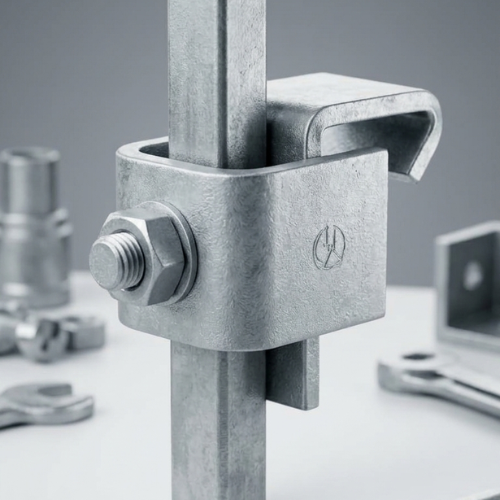
Cleat Clamp for Earthing Flat and Structure
| Flat sizes | 75×12 mm and 50×6 mm GS flat |
| Body | Mild steel, 3 mm, single piece |
| Fastener | 1 no. M12x55 bolt, nut tack-welded |
| Finish | Hot-dip galvanized |
| Weight | Approx. 0.290 kg (75×12) |
| Voltage class | Up to 420 kV substations |
| Application | Earthing flat to structure |
Standards & references
- Clamp design to IS 2121
- Galvanizing to IS 1573, service condition 3
- Made to the PGCIL 400 kV class GA drawing pattern
- Dimensional tolerance plus or minus 3 percent
- Non-current-carrying: no type tests required
Vaibhav Laxmi Industries (VLI) manufactures cleat clamps for GS earthing flats used to fix 75×12 mm and 50×6 mm galvanized steel flats to substation structures, equipment supports and tower legs. Each clamp is a single-piece hot-dip galvanized mild steel body with a tack-welded M12 nut and an M12x55 bolt, made to the general arrangement drawing pattern used on 400 kV class Indian substations and referenced to IS 2121 and IS 1573.
Cleat clamp types we offer
Cleat clamp for substation flats
A general-purpose cleat clamp for fixing GS earthing flats to steel structures, equipment support legs, cable trenches and marshalling kiosks inside a substation. VLI makes these to the customer’s approved GA drawing or to standard PGCIL-pattern dimensions, in the flat width and thickness specified in the earthing layout. The clamp holds the flat firmly against the structure so the earthing run stays in place through thermal movement and fault-current forces without any welding at site.
Cleat clamp for 75×12 mm and 50×6 mm GS flat
The two standard sizes used on 400 kV, 220 kV and 132 kV substations. The 75×12 mm clamp is the main earthing grid riser size; the 50×6 mm clamp is used for equipment earthing tails and lighter runs. Both share the same design: a U-formed 3 mm mild steel body with a 15 mm bend radius that wraps the flat, a nut tack-welded on the back face, and one M12x55 bolt that clamps the flat and the structure together.
Technical specification
| Parameter | Cleat clamp for 75×12 mm GS flat | Cleat clamp for 50×6 mm GS flat |
|---|---|---|
| Description | Cleat type clamp for 75×12 mm GS flat and structure | Cleat type clamp for 50×6 mm GS flat and structure |
| Connector body | Mild steel, 3 mm thick, single piece | Mild steel, single piece, sized for 50×6 mm flat |
| Nominal body size | 95 mm x 70 mm x 38 mm, 15 mm bend radius | Proportionate to flat size; dimension sheet on request |
| Bolt and nut | 1 no. M12x55 mild steel bolt with nut; M12 nut tack-welded to body | 1 no. M12 mild steel bolt with nut; nut tack-welded to body |
| Galvanizing | All ferrous parts, bolt, nut and flat washer hot-dip galvanized; spring washer electro-galvanized to suit service condition 3 of IS 1573 | |
| Reference standard | IS 2121 (clamps for earthing and lightning protection conductors) | |
| Dimensional tolerance | Plus or minus 3 percent on major dimensions | |
| System voltage | Up to 420 kV (400 kV class substations) | |
| Weight (approx.) | 0.290 kg | Lighter; stated on the dimension sheet |
| Type tests | Corona and RIV, short circuit, temperature rise, resistance and tensile tests are not applicable to cleat clamps because they are non-current-carrying earthing hardware. Routine checks cover dimensions, zinc coating mass and adherence. | |
Materials and galvanizing
The clamp body is pressed from mild steel plate and formed in one piece, so there are no welded joints in the load path; the only weld is the tack that holds the M12 nut in place for single-spanner tightening. All ferrous parts are hot-dip galvanized at VLI’s own galvanizing facility in Jaipur, and spring washers are electro-galvanized to the grade required for service condition 3 of IS 1573, the outdoor and severe-exposure condition that substation hardware must meet. Galvanizing is done after forming so the cut edges and the bend are fully coated.
Where cleat clamps are used
- Fixing 75×12 mm GS flat risers from the buried earth mat to switchyard structures, gantries and equipment support legs
- Fixing 50×6 mm equipment earthing tails to transformer tanks, circuit breaker and isolator structures, CT and PT supports
- Earthing of cable trench covers, marshalling kiosks, control cabinets and fences inside the switchyard
- Connecting the tower earthing strip to the leg member on transmission line towers where a bolted joint is required at the chimney top
- Solar plant and railway traction substation earthing where flat-to-structure fixing is specified
Why cleat clamps instead of welding the flat
Substation specifications require that earthing connections remain visible for inspection and that individual electrodes and runs can be tested, which a bolted cleat allows and a site weld does not. A bolted clamp also avoids burning the zinc coating off the flat and the structure, which is the main cause of corrosion at welded earthing joints. Because cleat clamps do not carry load current in normal operation, the PGCIL rule that current-carrying clamps rated 500 A and above must have at least four bolts does not apply, and a single M12 bolt is the accepted design.
Approvals and supply record
VLI supplies earthing materials, including GS flats, earthing pipes, counterpoise wire and clamps, to EPC contractors working on PGCIL, state transmission utility and railway projects. Cleat clamps are supplied with material test certificates for the steel and galvanizing, a dimension sheet against the approved drawing, and packing lists by size. Where the project requires drawing approval, VLI prepares the GA drawing in the client’s format for submission.
How to order
Send the flat size (width x thickness), the number of clamps per size, the required galvanizing grade and, if available, the approved earthing drawing or BOQ line. VLI quotes per piece with delivery from Jaipur to any project site in India. For 400 kV and 765 kV packages we can supply the full earthing hardware set, including flats, pad type clamps for earth wire to flat, and tower leg lugs, from one source.
Call +91 9660340624 or email sales@vaibhavlaxmiindustries.com for a quotation.
Frequently asked questions
What is a cleat clamp used for in a substation?
A cleat clamp fixes a galvanized steel earthing flat to a steel structure without welding. It holds the flat in place along its run and at riser points so the earthing connection stays tight, visible and testable.
Which flat sizes do VLI cleat clamps fit?
The standard sizes are 75×12 mm and 50×6 mm GS flat, the two sizes used on 400 kV, 220 kV and 132 kV substations. Clamps for other substation flat sizes are made to drawing.
Is the cleat clamp suitable for 400 kV substations?
Yes. The design follows the general arrangement pattern used for 400 kV class (420 kV system) clamps and connectors on Indian substations, with hot-dip galvanized mild steel construction to IS 2121 and IS 1573 service condition 3.
Do cleat clamps need type tests such as short circuit or temperature rise?
No. Those tests apply to current-carrying clamps and connectors. Cleat clamps are non-current-carrying earthing hardware, so they are accepted on dimensional check, material certificates and galvanizing tests.
What is the weight and bolt size of the 75×12 mm cleat clamp?
Approximately 0.290 kg per clamp, with one M12x55 bolt and nut. The nut is tack-welded to the clamp body so the bolt can be tightened from one side.
Can VLI supply cleat clamps with the earthing flat?
Yes. VLI manufactures GS earthing flats, earthing pipes and rods, counterpoise wire and the associated clamps, so the complete earthing hardware for a substation or transmission line can be supplied together.
Notice: Undefined variable: cat_name in /home/kjhgjjco/vaibhavlaxmiindustries.com/wp-content/themes/betheme-child/single-vli_products.php on line 275