Barbed Wire Fencing Cost and Design: Strands, Post Spacing and IS 278 Wire Gauge

Earthing Rod Types, Sizes and Prices in India: Copper Bonded vs GI vs Pure Copper
September 17, 2026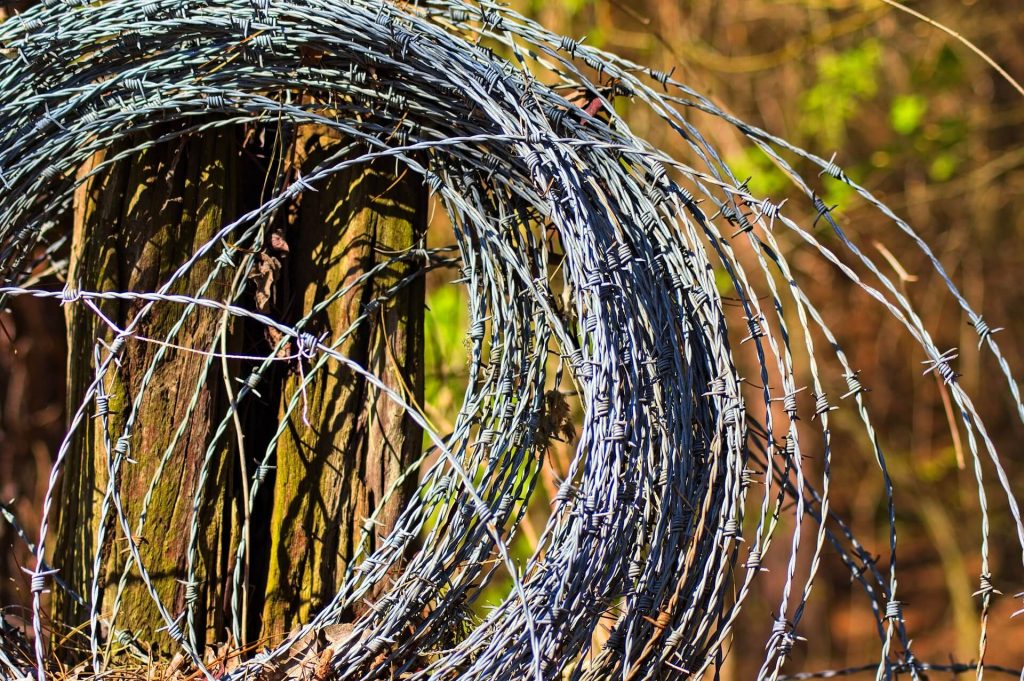
A barbed wire fence is priced by three decisions: the wire size under IS 278, the number of strands, and the post spacing. Get those three right and the cost per running metre falls out of simple arithmetic. Get them wrong and the fence either sags within a season or costs far more than your boundary needed. This guide sets out what IS 278 specifies, which gauge to use where, and how many strands a fence needs by height. It then covers post spacing and foundations and ends with a worked cost estimate for a 100 m boundary.
What does IS 278 specify for fencing barbed wire?
IS 278:2009 is the Bureau of Indian Standards specification for galvanized steel barbed wire used in fencing. It fixes the wire diameters, barb geometry, mass per metre and zinc coating that a reel must meet. The standard covers two barb types and six wire sizes (IS 278:2009, clauses 4 to 7 and Table 1).
- Type A (Iowa type): each four-point barb is formed by twisting two point wires two turns each around both line wires.
- Type B (Glidden type): the same four-point barb, but wound around one line wire only. Type B is the common commercial pattern in India.
- Barb length: 13 to 18 mm, cut sharp at an angle of no more than 35 degrees.
- Barb spacing: 75 mm or 150 mm, with a tolerance of 12 mm either way.
- Material and coating: mild steel wire to IS 280, hot-dip galvanized to the medium or heavy coating class of IS 4826, or electrogalvanized to IS 12753. The 2009 revision raised the minimum from a light coating to medium or heavy.
- Chromating: an optional chromate conversion coating to IS 1340 that buyers such as transmission utilities specify for extra corrosion resistance.
- Line wire continuity: welds in the line wire must be at least 15 m apart and no splicing is allowed.
| IS 278 size | Line wire (mm / SWG) | Point wire (mm / SWG) | Barb spacing | Mass (g per metre) |
|---|---|---|---|---|
| 1 | 2.50 / 12 | 2.50 / 12 | 75 mm | 136 to 155 |
| 2 | 2.50 / 12 | 2.50 / 12 | 150 mm | 108 to 120 |
| 3 | 2.50 / 12 | 2.00 / 14 | 75 mm | 108 to 125 |
| 4 | 2.50 / 12 | 2.00 / 14 | 150 mm | 89 to 103 |
| 5 | 2.24 / 13 | 2.00 / 14 | 75 mm | 97 to 106 |
| 6 | 2.24 / 13 | 2.00 / 14 | 150 mm | 78 to 85 |
A reel is designated by type and size, for example “Steel Barbed Wire A-1 IS 278” for Type A, size 1. Every reel must be marked with the manufacturer, type, line and point wire diameters, barb spacing and reel length or mass, and it may carry the BIS Standard Mark under licence.
Which barbed wire gauge should you use?
Use 12 SWG (2.50 mm) line wire, IS 278 sizes 1 to 4, for security and boundary fencing. Use 13 SWG (2.24 mm) line wire, sizes 5 and 6, for farm and livestock fencing where cost per metre matters more than cut resistance. Within each group, the 75 mm barb spacing (sizes 1, 3 and 5) is the deterrent option and the 150 mm spacing (sizes 2, 4 and 6) is the economy option.
The mass figures in IS 278 make the trade-off visible. Because a reel is sold by weight, the metres you get per kilogram depend on the size. Dividing 1,000 g by the nominal mass per metre from Table 1 gives the following coverage. The calculation uses the mid-point of each IS 278 mass range, so the actual figure will sit within the range shown.
| IS 278 size | Nominal mass | Metres per kg (approx.) | Kilograms per 100 m of strand |
|---|---|---|---|
| 1 (12 x 12 SWG, 75 mm) | 146 g/m | 6.8 m | 14.6 kg |
| 2 (12 x 12 SWG, 150 mm) | 114 g/m | 8.8 m | 11.4 kg |
| 3 (12 x 14 SWG, 75 mm) | 117 g/m | 8.5 m | 11.7 kg |
| 4 (12 x 14 SWG, 150 mm) | 96 g/m | 10.4 m | 9.6 kg |
| 5 (13 x 14 SWG, 75 mm) | 102 g/m | 9.8 m | 10.2 kg |
| 6 (13 x 14 SWG, 150 mm) | 82 g/m | 12.2 m | 8.2 kg |
Size 4 is the most common choice for industrial and utility boundaries in India. It keeps the 12 SWG line wire for strength, while the lighter point wire and wider barb spacing save about a third of the weight against size 1. Substation and tower yard fences that carry a chromating requirement are normally specified as size 1 or size 3 Type A. For the barbed wire used on anti-climbing devices fitted to transmission towers, which has its own wrapping and length rules, see the separate VLI guide on that subject.
How many strands does a barbed wire fence need?
A boundary fence needs four to six horizontal strands for a 1.2 to 1.5 m fence. It needs six to eight strands plus diagonal cross wires when the fence reaches 1.8 m or must stop people rather than cattle. Fewer strands leave gaps that a person or an animal can push through; more strands than the height needs add weight and cost without adding security.
Government civil-works specifications set the pattern for high-security fencing. The Department of Atomic Energy’s civil specification, for example, fixes the bottom strand 140 mm above ground with the remaining strands at 125 mm spacing or as drawn. It requires two diagonal wires in every bay, running from the top wire on one post to the bottom wire on the next. It also forbids joints in the barbed wire between posts (DAE/DCSEM Specifications for Civil Works 2009, clause 61.5.1). That pattern gives a 1.8 m fence roughly 13 strands and is the reference when a tender simply says “barbed wire fencing as per standard specification”.
| Fence purpose | Height | Strands | Strand spacing | Diagonals |
|---|---|---|---|---|
| Plot demarcation, cattle | 1.2 m | 4 | 250 to 300 mm, bottom strand close to ground | None |
| Farm boundary, stray animals | 1.5 m | 5 to 6 | 200 to 250 mm | Optional |
| Industrial yard, warehouse | 1.8 m | 6 to 8 | 150 to 200 mm | Two per bay recommended |
| Substation, tower yard, government sites | 1.8 m or as specified | As per specification (DAE pattern: 125 mm spacing) | 125 mm, bottom strand 140 mm above ground | Two per bay mandatory |
Whatever the strand count, you must strain the wire tight at the end and corner posts with turnbuckles or straining bolts. Otherwise the middle of each bay sags within a season and the fence can be lifted. Strand spacing and heights above are common design practice rather than a standard requirement; the DAE clause is the only published Indian specification that fixes them.
Post spacing, post types and foundations
Intermediate posts are set 2.5 to 3 m apart on level ground. Corner, end and gate posts are strutted or set in larger concrete blocks because they carry the full tension of the strained wires. On slopes and at changes of direction, the spacing is reduced so the wire follows the ground without leaving a gap under the bottom strand.
| Post type | Typical section | Where used | Notes |
|---|---|---|---|
| MS angle post | 50 x 50 x 6 mm, hot-dip galvanized or painted, 1.8 to 2.4 m long | Industrial, utility and railway boundaries | Pre-drilled or punched holes for each strand; VLI supplies galvanized fence posts cut and drilled to drawing |
| RCC post | 100 x 100 mm or 125 x 100 mm precast, 1.8 to 2.4 m | Farms, plots, government compounds | Wire fixed through 10 mm holes with U-clamps turned 25 mm over the face, per the DAE specification |
| GI pipe post | 40 to 50 mm nominal bore, medium class | Substation and switchyard fencing, gates | Pairs with chain link and a barbed topping |
| Rail pole | Old rail section, 30 R to 90 R | Heavy boundaries and crash-prone edges | Very high strength; needs drilling or welded lugs |
Post foundations are the part most often skimped. A line post needs a hole about 450 to 600 mm deep, filled with lean concrete around the post. Corner and end posts go deeper, to 600 to 900 mm, with a strut or a larger block so the strained wire cannot pull the post over. A 45-degree strut from the end post to a small concrete block is cheaper than a larger post and holds better. Once the concrete has set, the wire is strained, fixed strand by strand from the bottom, and the diagonals are woven through the horizontals where they are specified.
How much does barbed wire fencing cost per metre?
An installed barbed wire boundary fence in India costs in the region of 165 to 250 rupees per running metre for a 4-strand fence on concrete posts. That band comes from a cost breakdown published by the Karnataka farm advisory Organic Mandya in March 2026 (Farm Fencing Complete Guide). The cost rises towards 300 rupees per metre and beyond for 6 to 8 strands on galvanized steel posts with diagonals. The wire itself is a minority of that figure; posts, foundations and labour make up most of the cost.
The estimate below works through a 100 m industrial boundary so that each input can be swapped for your own site. It uses IS 278 size 4 wire, five strands, two diagonals per bay and MS angle posts at 3 m.
| Item | Quantity | How it was calculated |
|---|---|---|
| Bays and posts | 34 bays, 35 line posts plus 2 end posts with struts | 100 m divided by 3 m spacing, rounded up, plus one |
| Horizontal wire | 500 m | 100 m x 5 strands |
| Diagonal wire | 240 m | 34 bays x 2 diagonals x about 3.5 m each (3 m bay, 1.8 m height) |
| Wire allowance | 40 m | About 5 percent for straining and end wraps |
| Total wire | 780 m, about 75 kg | 780 m x 96 g/m nominal for size 4, rounded |
| Fixings | About 300 U-clamps or binding wire ties, 4 turnbuckles or straining bolts | 7 wires x 37 posts plus end straining |
| Concrete | About 2 cubic metres | 37 holes x 0.3 x 0.3 x 0.6 m |
To price the estimate, apply your quoted rates. Barbed wire in India is sold per kilogram. In September 2026, galvanized IS 278 wire is quoted at roughly 60 to 90 rupees per kilogram on published seller listings, and PVC-coated and high-tensile grades cost more. Galvanized angle posts are quoted per piece by section and length, and fencing labour is quoted per running metre. On those bands the wire for the 100 m example comes to about 4,500 to 6,800 rupees. The post and labour lines, not the wire, decide whether your fence lands at 165 or 300 rupees per metre. For a firm quotation on wire and posts together, ask VLI for the barbed wire and post package by the running metre.
Barbed wire topping on chain link fences and walls
A barbed topping adds height and a deterrent to a chain link fence or a boundary wall without rebuilding it. The usual arrangement is three strands of IS 278 size 1 or size 3 wire carried on Y-arms or single outrigger arms bolted to the post tops. The arms are angled outward at about 45 degrees so that the strands overhang the approach side.
Substation and switchyard fences built to utility drawings normally combine a 2 m chain link panel on GI pipe posts with a three-strand barbed topping. The whole fence is bonded to the earthing system so that a fault cannot leave the fence at a dangerous potential. On boundary walls the same three strands sit on angle brackets set into the coping. Where a topping needs to stop a determined climber rather than mark a boundary, concertina coil is the alternative; VLI’s concertina wire and chain link fencing pages cover those options.
How do you specify barbed wire in a tender or purchase order?
Specify barbed wire by its IS 278 designation, its coating class and its reel length, and ask for the test certificate with delivery. A purchase order that says only “barbed wire, 12 gauge” leaves the point wire, barb spacing and zinc coating to the seller. A complete line reads, for example: “Galvanized steel barbed wire, Type B, size 4, IS 278:2009, heavy coating to IS 4826, chromated to IS 1340, supplied in reels of 25 kg with manufacturer’s test certificate for wire diameter, mass per metre, tensile strength and zinc coating mass.”
- Type and size: A or B, size 1 to 6, which fixes both wire diameters and the barb spacing.
- Coating class: medium or heavy to IS 4826; heavy for coastal, industrial or long-life fences.
- Chromating: state it if the drawing calls for it; transmission utilities usually do.
- Reel length or mass: so that the quantity can be checked on delivery and metres per kilogram reconciled against Table 1.
- Tests: the IS 278 tests are wire diameter, mass per metre, tensile test on the line wire, wrapping test for ductility, and zinc coating mass and uniformity. Ask for the certificate rather than the promise.
- BIS mark: where the tender requires ISI-marked wire, state it, and check the reel marking on delivery.
The same order should carry the posts, struts, U-clamps and turnbuckles. A fence bought as one package from one supplier is easier to reconcile on site than wire from one source and posts from another. VLI supplies the wire, galvanized angle posts and fixings together from Jaipur, and hot-dip galvanizes the posts in its own plant.
Frequently asked questions
How many metres of barbed wire are in one kilogram?
Between about 7 and 12 m depending on the IS 278 size. Size 1 (12 SWG line and point wire, 75 mm barbs) gives about 6.8 m per kilogram at its nominal 146 g/m. Size 4 gives about 10.4 m and size 6 about 12.2 m. Divide 1,000 by the mass per metre on the reel label to check any reel.
Which barbed wire is best for a farm fence?
IS 278 size 5 or 6 (13 SWG line wire, 14 SWG point wire) is the usual farm choice. It costs less per metre and still deters cattle and goats when run as 4 to 6 strands. For fences that must stop people or that stand near the coast, move up to size 3 or 4 with a heavy zinc coating.
How far apart should barbed wire fence posts be?
2.5 to 3 m for intermediate posts on level ground, closer on slopes and at corners. End, corner and gate posts must be strutted or set in larger concrete blocks because they take the full tension of the strained wires.
How high should a barbed wire fence be?
1.2 m is enough for plot demarcation and cattle, 1.5 m for a farm boundary against stray animals, and 1.8 m with diagonals for an industrial yard or a substation. Local municipal bye-laws cap boundary height in some cities, so confirm the permitted height before ordering posts.
Does barbed wire need to be galvanized?
Yes. IS 278 requires galvanized wire, and since the 2009 revision the minimum is the medium or heavy coating class of IS 4826. Ungalvanized or lightly coated wire rusts through at the barbs within a few seasons and the fence loses tension.
Can barbed wire be used as a wall topping legally?
In most Indian cities yes, provided the topping does not overhang a public footpath and cannot injure passers-by. Rules differ by municipality and some housing societies restrict razor wire, so check the local bye-laws and society rules before specifying a topping.